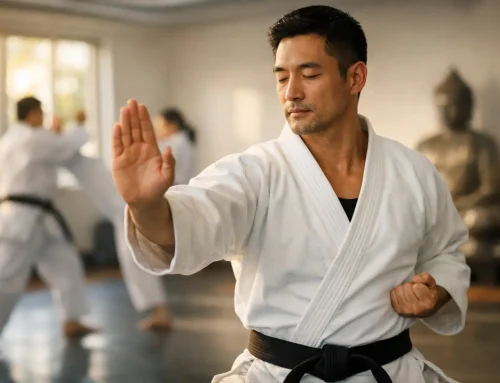
A person grabs your wrist. The first impulse may be to pull away harder, freeze, or meet force with force. Aikido asks a different question: Can you stay aware, keep your balance, and choose a safer response? That question makes aikido more than an exercise class. It becomes a practice in confidence, self-control, and respectful connection.
For children, teens, and adults, that approach can feel especially welcoming. Not everyone wants a martial art centered on winning a match or proving how tough they are. Many people want to move better, feel safer, build discipline, and learn in a community where progress is encouraged. Aikido offers a meaningful path toward those goals.
What Is Aikido?
Aikido is a Japanese martial art built around awareness, movement, balance, and redirecting energy. Rather than trying to overpower an attacker, practitioners learn to recognize an incoming motion, move off the line of force, and guide that energy into a controlled technique.
Training often includes wrist releases, throws, pins, footwork, posture, and safe falling skills. The goal is not to hurt a training partner. It is to develop control while protecting both people involved. That makes cooperation a central part of the learning process, even when the techniques themselves address serious situations such as grabs, pushes, or strikes.
The name is often interpreted through three ideas: harmony, energy, and path. In practical terms, aikido teaches students to remain centered under pressure rather than reacting with panic or aggression. That lesson can show up far beyond the mat.
Aikido is not one single experience everywhere. Schools may emphasize different techniques, pacing, traditions, or training goals. A supportive instructor and a culture of safety matter as much as the curriculum, particularly for beginners and younger students.
Why Aikido Feels Different From Other Martial Arts
Many martial arts teach valuable skills, and each has its own strengths. Aikido stands apart because it puts unusual emphasis on timing, positioning, and cooperative practice. Students do not need to be the biggest or strongest person in the room to begin learning useful principles.
That does not mean aikido is effortless. Good technique requires coordination, repetition, patience, and attention to detail. Moving at the right moment, keeping a stable posture, and protecting a partner during a technique can be demanding. The challenge is simply different from a training style built mostly around sparring or direct exchanges.
For many families, this can be a healthy fit. Children can learn that strength includes restraint. Teens can practice handling pressure without escalating it. Adults can reconnect with their bodies while learning skills that reward calm thinking instead of brute force.
The lesson behind redirecting force
Redirecting force is not the same as giving in. It means noticing what is happening clearly enough to make a better choice. If someone pulls, a student learns not to lock up and fight the pull blindly. If a situation feels tense, the first response can be to create space, stay balanced, use a clear voice, and look for a safe exit.
That principle has emotional value, too. Aikido training can help students recognize the difference between being passive and being peaceful. They can set boundaries, communicate with confidence, and avoid adding fuel to a conflict whenever possible.
Aikido and Real-World Self-Defense
A responsible self-defense conversation starts before a technique. Awareness, distance, verbal boundaries, and leaving danger are often safer and more realistic than trying to perform a complicated move. Aikido can support those habits by teaching students to pay attention to body position, momentum, and the behavior of others.
Students should also understand the limits of any martial art. No class can guarantee a person will be safe in every situation, and techniques practiced slowly with a willing partner may be difficult to apply during a stressful, unpredictable encounter. Size differences, surfaces, surprise, multiple people, and adrenaline all change the equation.
The value of training is preparation, not false certainty. Repetition helps students become less likely to freeze. It gives them experience with movement, physical contact, and staying composed when something unexpected happens. The most practical outcome may be the confidence to use good judgment early: speak up, move away, seek help, and avoid danger when possible.
For kids and teens, those lessons fit naturally alongside anti-bullying education. Martial arts should never encourage a child to solve every conflict physically. Instead, a strong program reinforces respect, reporting concerns to trusted adults, setting clear limits, and using physical skills only when safety truly requires it.
What Beginners Can Expect in an Aikido Class
The first class is usually less about getting every detail right and more about learning how the space works. Students may practice basic stances, stepping patterns, partner etiquette, and simple movements before working through a technique. There is no need to arrive already flexible, athletic, or knowledgeable about martial arts.
A quality class makes room for questions and gradual progress. Beginners should be shown how to practice at a manageable pace, how to communicate if something is uncomfortable, and how to keep their partner safe. Controlled repetition matters more than rushing to learn advanced throws.
Falling safely, often called breakfall training, is an important part of aikido for students who are ready for it. It is introduced progressively. The purpose is not to make anyone take hard falls before they feel prepared. It is to teach body awareness and safe habits over time, with appropriate instruction and supervision.
Parents may appreciate that partner training also develops social skills. Students must take turns, listen closely, respect personal space, and adjust their intensity. Those are valuable habits for school, friendships, work, and family life.
Progress is personal
Some students love the physical challenge right away. Others need time to grow comfortable with being close to a partner or trying unfamiliar movements. Both experiences are normal. The best measure of progress is not whether someone learns a flashy technique quickly. It is whether they are becoming more focused, coordinated, respectful, and confident.
Consistent attendance helps because aikido is learned through feel as much as explanation. Over weeks and months, movements that once seemed awkward begin to make sense. A student notices their shoulders are less tense, their stance is steadier, or they can respond to a grab without immediately panicking.
Who Can Benefit From Aikido?
Aikido can be a strong choice for a wide range of people, but it is especially appealing to those who want martial arts training with a thoughtful, non-aggressive culture. Children may benefit from structure, coordination, and confidence. Teens may find a positive outlet for stress and a place to belong. Adults may enjoy a practice that challenges both body and mind without requiring a competition-focused environment.
It also works well for people returning to movement after time away, provided the class and instructor can support their needs. Anyone with an injury, a medical condition, or concerns about falling should speak with a healthcare professional and the instructor before participating. Training can often be adapted, but adaptation should be thoughtful rather than assumed.
At OC Training Studio, the larger purpose of martial arts is helping people become well-rounded, capable members of their community. That means creating room for beginners, celebrating steady effort, and treating every student with dignity. Affordable access and encouraging mentorship can make it easier for families to stay with a practice long enough to experience its deeper benefits.
The Confidence That Carries Off the Mat
The most lasting part of aikido may not be a throw or a wrist release. It may be the moment a quiet child stands a little taller, a teen chooses not to be pulled into an argument, or an adult realizes they can learn something new without needing to be perfect first.
Confidence grows when people repeatedly meet a challenge in a safe, supportive environment. Aikido gives students that opportunity: show up, practice with care, make mistakes, try again, and notice what has changed. The calm they build on the mat can become a resource they carry into the rest of their lives.